



If you want to get out of a title loan, you may have several options:
- Pay it off early
- Ask about payment options
- Refinance the loan
- Sell the car and use the proceeds to pay off the balance
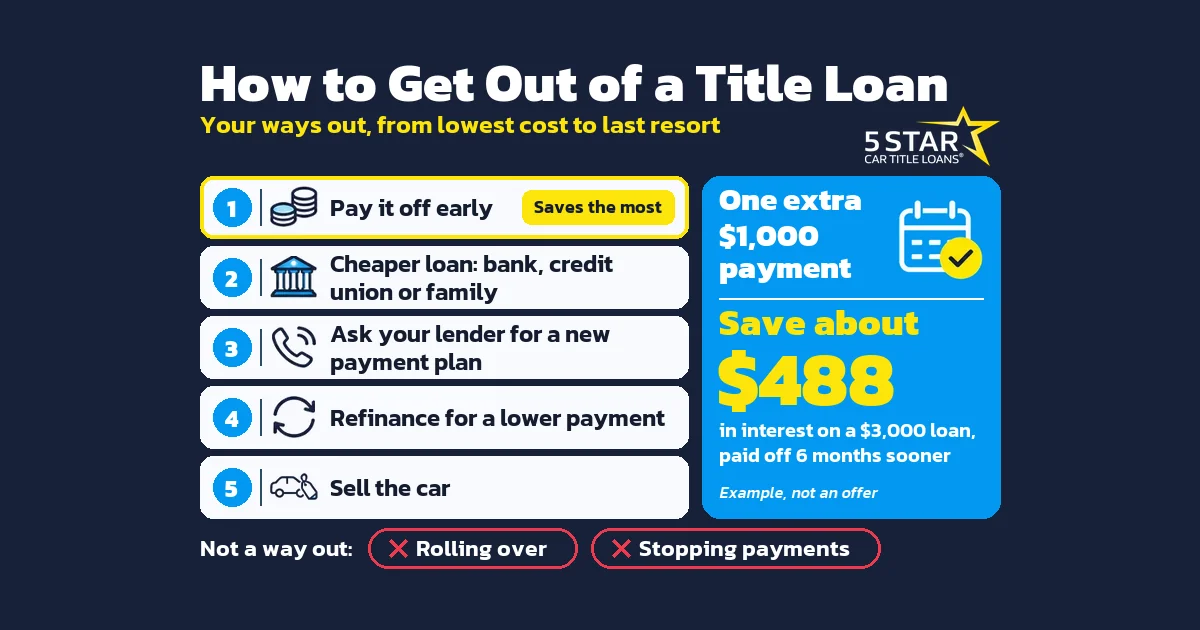
Start by contacting your lender before your next payment is due. Ask for your current balance, exact payoff amount, and whether any payment or refinance options are available.
You do not need to wait until you miss a payment to take action. In fact, acting early can give you more options.
Once the loan goes into default, your vehicle may be at risk of repossession under your loan agreement and state law.9
If you just took out the loan and changed your mind, check your state’s rules right away. Some states give borrowers a short period to cancel certain title loans by returning the money.
Editorial Disclosure: 5 Star Car Title Loans™ is a licensed direct lender, NMLS ID 2253575. This guide is for informational purposes only and is not financial advice. Your loan approval, amount, APR and terms depend on your state’s law, your car and your income.
Key Takeaways
The most common ways to get out of a title loan, starting with the lowest-cost options:
| Option | What It Means |
|---|---|
| Pay it off early | Usually saves the most interest. With us, there is no prepayment penalty. |
| Use a cheaper loan | A bank, credit union or family loan may cost less and can pay off the title loan. |
| Ask about a payment plan | Contact your lender before the due date. A new arrangement may make payments easier, but could increase the total cost. |
| Refinance the loan | Where your state’s law allows, a lower payment may be easier to keep up with, but a longer term can mean paying more overall. |
| Sell the car | Your lender must be paid first and release its lien before the title can go to the buyer. You give up the vehicle and pay any amount the sale doesn’t cover. |
| Chapter 13 bankruptcy | A last-resort legal option. Whether you can keep the car depends on your case. |
What usually does not solve the problem:
- Rolling the loan over, paying only the fee to push back the due date, can add more interest or fees and keeps your vehicle at risk.
- Stopping payments can lead to late fees, default and possible repossession under your state’s law.
How Do Most Borrowers Pay Off a Title Loan?
Most borrowers pay off a title loan with their own money or a one-time sum.
In a Pew Charitable Trusts survey of title loan borrowers, 57% said they had or saved enough money to repay, and 47% used a lump sum from somewhere else, often from more than one source:
- A tax refund: 21%
- Money from family or friends: 19%
- A loan from a bank or credit union: 11%
- Another short-term loan: 8%
- Pawning or selling things they own: 8%
- A credit card: 3%
The survey is from 2015, so treat the shares as a guide, not as exact numbers for today.
Paying with another short-term loan or a credit card moves the debt to a new place rather than ending it, so compare its total cost first.
How Do You Pay Off a Title Loan Early?
You can pay off a title loan in one payment or pay extra toward the balance over time.
If your loan is with us, contact us for your current payoff amount. With any lender, get the payoff amount in writing and ask:
- How long the payoff amount is valid
- How extra payments are applied
- Whether any payoff fee applies
How Can You Pay It Off Faster?
Not everyone can pay off a title loan all at once, but that does not mean you should skip paying extra when you can.
Even a small extra payment toward your balance can shorten the loan and reduce the interest you pay over time.
An extra $100, $500 or $1,000 can make a difference, depending on your balance, rate and term. If your loan is with us, you can use any of our payment options to make an extra payment.
How Much Could an Extra Payment Save?
The savings depend on how much extra you pay and how early you pay it.
On a $3,000 California title loan at about 40% APR, the most California law allows, over 18 months, making an extra $1,000 payment after the third payment could reduce total interest from about $1,038 to $550.
That is a savings of about $488 in interest, and the loan is paid off 6 months sooner.
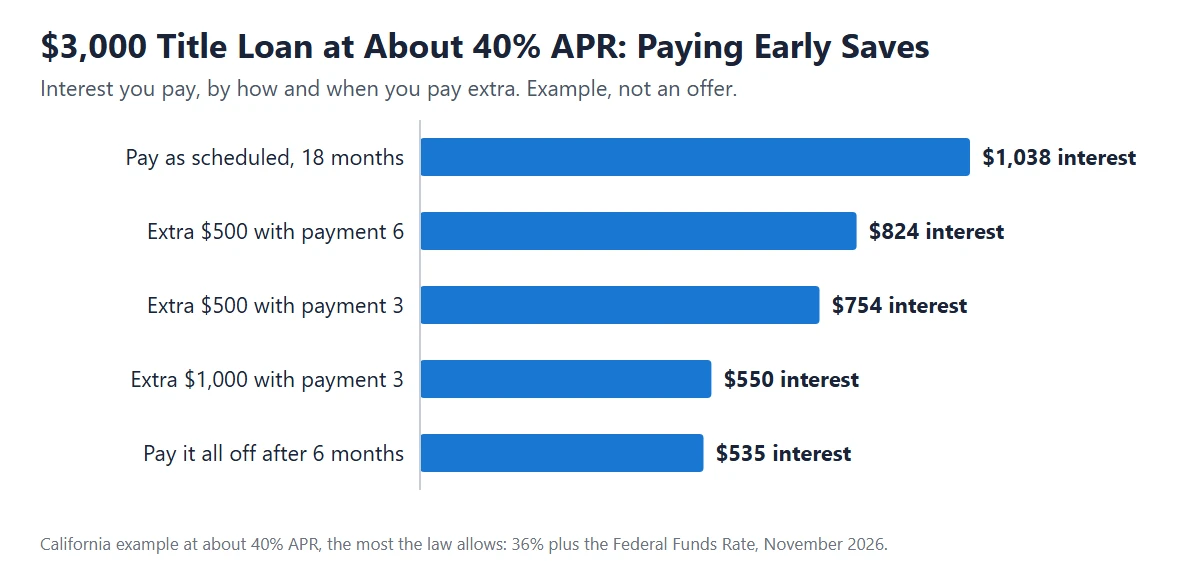
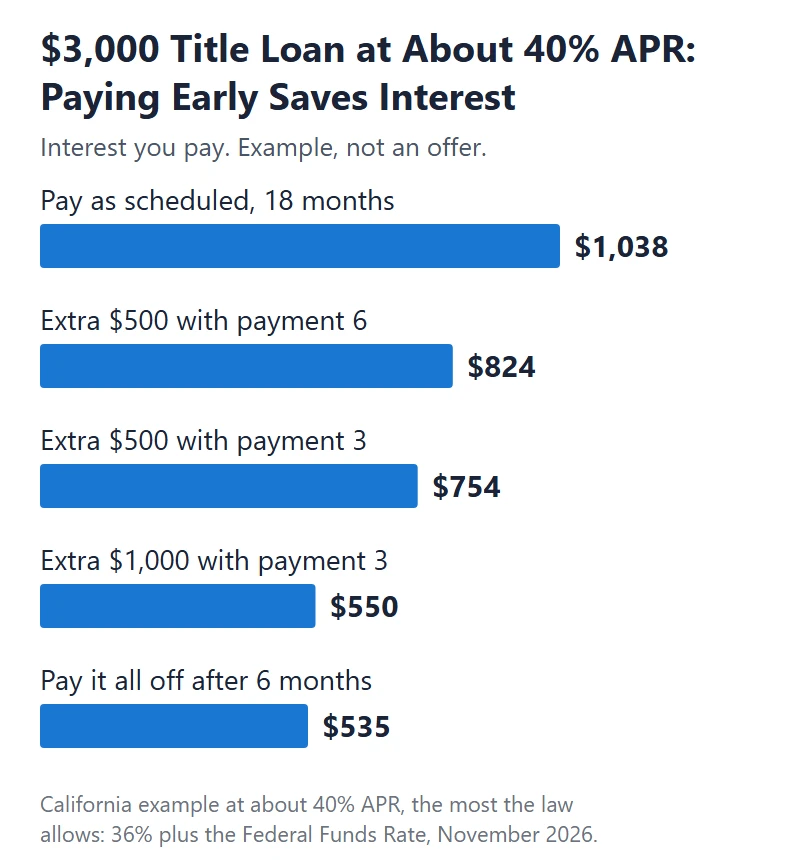
Disclaimer: This chart is only an example, not an offer.
Can a Credit Union or Bank Loan Pay Off a Title Loan?
Yes, if you qualify. Some federal credit unions also offer small Payday Alternative Loans, with a rate the NCUA caps at 28% a year.
If a new loan is not available, a nonprofit credit counselor may be able to review your budget and other options, often for free or at a low cost.
What Can You Do If You Cannot Keep Up With the Payments?
Ask your lender what options may be available, such as a new payment plan or due date, and whether a late fee can be waived if you get back on track.
Call even if you’ve already missed a payment, and get any changes in writing.
What Can We Do If Your Title Loan Is With Us?
If you think you might miss a payment, contact us as soon as possible. We cannot promise the same option for every borrower, but depending on your loan and state law, we may be able to:
- Refinance the loan with a more manageable payment
- Accept a partial or slightly late payment
- Adjust your due date
“When you contact us before missing a payment, I look first at what fits your monthly budget.
We try to find an option that can work for both you and us, because default is not a good outcome for either side.
A new due date or refinance only makes sense if the payment is affordable. Otherwise, you may end up in the same situation again when the next payment is due.”
Bryan Solis
Head of Underwriting, 5 Star Car Title Loans™
Can You Refinance a Title Loan?
Yes, refinancing may be an option. Your current lender may offer new terms on your title loan, or another lender may pay off your existing loan and replace it with a new one.
At 5 Star Car Title Loans™, we may be able to refinance a title loan you already have with us or pay off a title loan from another lender, where your state’s law allows.6
Before approving any title loan refinance, we consider your vehicle’s value, how much you still owe on it, your income, and your ability to repay the new loan.5 Approval is not guaranteed.
Be aware that refinancing often lowers your monthly payment by extending the loan term.
That can make the payment easier to manage, but it may also increase your total cost, and your vehicle still secures the new loan.
Before refinancing, compare the APR, monthly payment, loan term and total repayment.
Apply NowCan You Sell Your Car to Pay Off a Title Loan?
Yes, but your lender has to be part of the sale, and many loan agreements require the lender’s written OK before you sell.
If the sale doesn’t bring in enough to pay what you owe, you cover the difference yourself.
To sell a car that has a title loan:
- Ask your lender for your payoff amount and how it handles a sale.
- Pay the lender first. You can pay off the loan before you sell, or the buyer or a dealer can pay your lender directly at the sale.
- The lender releases its lien, its legal claim on your title, and the title can go to the buyer.
What Rights Do You Have as a Title Loan Borrower?
Your state’s law decides what rights you have if you fall behind, such as notice before the sale, time to get your car back after repossession, or limits on what you can still owe after the sale.
If you believe a lender is not following your agreement or your state’s law, you can submit a complaint to the CFPB.
Indiana and Virginia give you 3 business days to cancel a new title loan if you return the money, and South Carolina and Tennessee give you until the end of the next business day.
| State | If You Fall Behind |
|---|---|
| California | Notice after repossession; any money left after the sale is returned to you |
| Florida | Lenders must accept partial payments; 10 days’ written notice before the sale; pay the full balance before then to keep the car; you won’t owe more after the sale |
| Indiana | You may still owe what the sale doesn’t cover |
| Kentucky | Written notice after repossession; pay all you owe plus costs before the sale to get the car back |
| Louisiana | Written notice before repossession; pay all you owe plus costs to get the car back |
| Ohio | You may still owe what the sale doesn’t cover |
| Oklahoma | Written notice before the sale; pay all you owe plus costs to get the car back |
| South Carolina | After 6 renewals, no more interest, and the rest is paid in 6 monthly payments; you won’t owe more after the sale |
| Texas | Repossession may come without advance warning, but you get reasonable notice before the sale; you may owe what the sale doesn’t cover |
| Virginia | 10 days’ written notice before the sale, and paying what you owe plus fees in that time stops it; you won’t owe more after the sale |
Disclaimer: This is a short summary, not legal advice. Your state page and loan agreement explain the rules that apply to your loan.
Frequently Asked Questions
Can You Get Out of a Title Loan With Bad Credit?
You can get out of a title loan with bad credit, because most ways out, like paying early or changing your payment plan, generally do not depend on your credit score.
You may also still qualify to refinance with us, because approval depends more on your car’s value and your ability to repay than on your credit score.
No credit check is required to pre-qualify. If you decide to proceed, we may run a soft credit check during final approval, which won’t affect your FICO score.
Does Paying Off a Title Loan Affect Your Credit?
No. We do not report your loan or your on-time payments to Equifax, Experian or TransUnion, so paying on time will not raise your score.
We do not report routine late payments either. If you default and we take a loss after repossessing and selling the car, or your balance goes to a collection agency, a negative mark can end up on your credit report.
What Should You Do If You Have Already Rolled Over Your Title Loan?
Try to avoid another rollover if possible. Each rollover leaves the amount you borrowed unpaid, so you keep paying fees without getting closer to paying off the loan.
Instead, ask your lender whether you can:
- Move to a different payment plan
- Pay toward the amount you borrowed, not just the fee, where your state’s law allows
- Refinance into a more manageable payment
The CFPB found that about 1 in 5 borrowers with single-payment title loans had their vehicle seized after failing to repay, which is why acting before another rollover can matter.
What Happens If You Stop Paying a Title Loan?
If you stop paying, your loan goes into default. Because your car secures the loan, your lender can repossess and sell it under your state’s law.
You may also still owe money if the sale does not cover the full balance and your state allows the lender to collect the difference.
How quickly a title loan repossession can happen depends on your state. In Florida, for example, a title loan is not considered in default until 30 days after it comes due.
Is There Title Loan Forgiveness?
Generally, no. Title loan lenders do not usually offer forgiveness programs, and we do not offer one.
Some lenders may agree to accept less than the full balance after a loan goes into default, but by then your car may already have been repossessed under your state’s law.
Be careful with companies promising a “loophole” that will make the debt disappear. The FTC warns that only scammers collect fees before they settle any of your debts.
Can Bankruptcy Get You Out of a Title Loan?
Bankruptcy may affect a title loan, but what happens to the debt and your car depends on your case. Chapter 13 bankruptcy generally uses a court-approved repayment plan.
Because bankruptcy has major legal and financial consequences, speak with a bankruptcy attorney before deciding whether it is right for you.